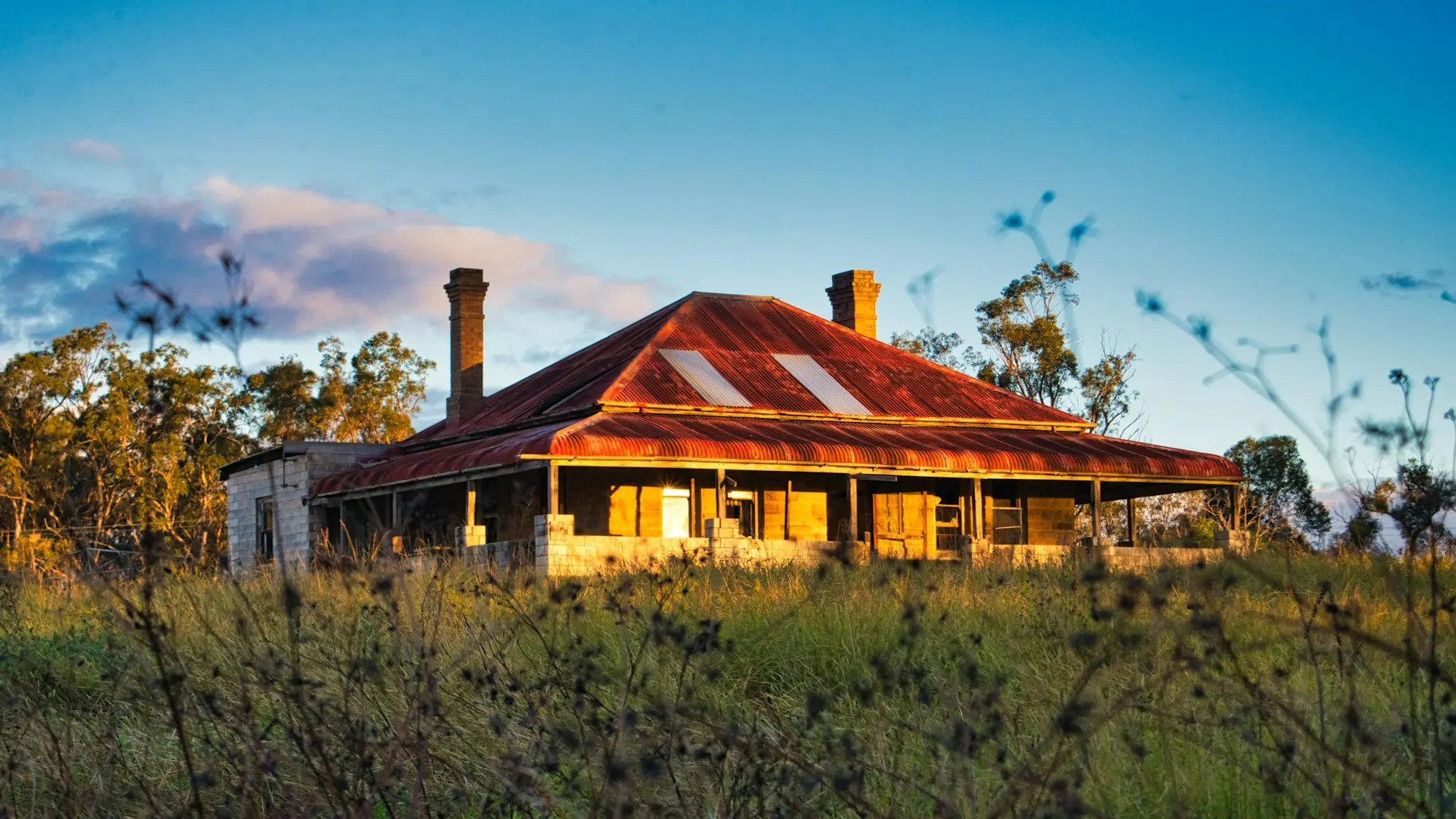
Quick answer
Regional and rural property can secure a short-term business loan from $20k to $5m. Houses and commercial property in regional cities and larger towns are treated much like metro property. Lifestyle blocks, small-town property and working farms are considered case by case, with more conservative valuations and longer lead times. Victorian titles use a caveat; elsewhere we use a registered second mortgage, or a first mortgage over a clear title.
Key points
- Regional cities and larger towns are generally straightforward security.
- Lifestyle blocks, small towns and working farms are considered case by case.
- Fewer comparable sales mean more cautious valuations and sometimes a smaller loan.
- Valuer availability and travel are the usual timing constraint — flag the location on day one.
- Same structures as the city: caveat in Victoria, registered second mortgage elsewhere, first mortgage on a clear title.
- Loan size
- $20k to $5m
- Main hurdle
- Comparable sales
- Timing driver
- Valuer availability
A plumbing business in Bendigo, a vet clinic in Dubbo, a machinery dealer outside Toowoomba — regional businesses hit the same cash crunches as city ones, often with a bank that’s further away and slower to move. If you own property outside the capitals, it can secure a short-term loan in the same way a suburban house can. The difference is mostly in the valuation, and that’s something you can plan for.
Can regional or rural property secure a short-term loan?
Yes. The question isn’t really “city or country?” — it’s “how many buyers would this property have, and how quickly could it sell?” That puts regional property on a sliding scale.
| Property | Typical lender appetite | Why |
|---|---|---|
| House in a regional city (Geelong, Ballarat, Newcastle, Townsville and similar) | Strong | Active markets, plenty of comparable sales |
| House in an established country town | Good | Steady demand, though fewer sales |
| Commercial property on a regional main street or industrial estate | Good | Local owner-occupiers and investors |
| Lifestyle block with a home near a regional centre | Good to case by case | Valued mainly as a home with land |
| Small or remote town property | Case by case | Thin market, slower sale |
| Working farm or large rural holding | Case by case | Specialised buyers, value tied to production |
Everything on that list can be considered. The further down it a property sits, the more conservative the valuation is likely to be and the more lead time it needs.
Does the structure change for country property?
No. The same rules apply as in the city:
- Victorian property, city or country — a caveat loan behind any existing bank mortgage. See caveat loans in Victoria.
- Every other state and territory — a short-term registered second mortgage behind the bank. It’s the standard form every country conveyancer and regional bank branch deals with, it’s recorded clearly on the title, and paying it out is a routine release. It’s usually arranged just as quickly as a caveat. More at caveat loans outside Victoria.
- A clear title anywhere — a short-term first mortgage.
Got a regional property and a deadline? Tell us the town and we’ll tell you what’s realistic before you spend time on paperwork.
Why are rural valuations more conservative?
Three reasons, all about evidence:
- Fewer comparable sales. A valuer needs recent sales of similar property. In a small town or a farming district there may be only a handful a year.
- Mixed value drivers. Rural land value can depend on soil, water, fencing, sheds and access as much as on the house.
- Longer selling times. If a property would take longer to sell, lenders leave a bigger buffer.
Official land valuations hint at how much the land itself matters outside the cities. The NSW Valuer General’s land value is the market value of the land only, worked out from recent sales and factors including use, location, size, zoning and the surrounding area. A lender’s valuer considers all of that plus the buildings, and adds the question every lender asks: what would this fetch, from a real buyer, in a reasonable time?
Our page on valuations for short-term loans explains the process in full.
What extra checks come up on rural titles?
- Zoning and overlays. In Victoria, a free planning property report shows the planning zone and overlays for an address, plus bushfire-prone area status and heritage listings. Other states have their own planning maps. Farming or rural zones can limit what a buyer could do with the land, which feeds into the valuation.
- Water. In Queensland, the titles office’s current title search also covers holders of water allocations. Where water matters to the value, tell us what entitlements go with the land.
- Multiple titles. Farms are often made up of several parcels. We need every title that forms the security, and every owner of each one.
- Access and services. Unsealed roads, bore water and off-grid power are all fine, but the valuer will note them.
A worked example: the country-town workshop
Illustrative only — round numbers, no real people.
A diesel mechanic in a Riverina town wins a maintenance contract with a regional transport company. He needs $90,000 for a hoist, diagnostic equipment and parts stock before the contract starts in three weeks.
He owns his workshop on the town’s light industrial strip, with no loan on it, and a house in town with a bank mortgage. The workshop is the cleaner security: it’s in NSW and the title is clear, so a short-term first mortgage is the fit. The valuer covering the district is booked the day he enquires and inspects four days later. The valuation is conservative, reflecting only a few comparable industrial sales in town, but a $90,000 loan against it sits at a very comfortable level.
Funds go out the day after the valuation report arrives. The exit is a refinance into an equipment loan once the contract has a few months of payments behind it. Short-term loans like this are measured in months, not decades.
How do you keep a regional deal moving fast?
- Name the town and property type in your first enquiry so the right valuer is booked immediately.
- Have someone ready to give access, especially on large or remote properties.
- Gather every title if the property is made up of more than one parcel.
- Collect payout figures early — regional bank branches can take a day or two.
- Pick the simplest security. A town house or commercial building may fund faster than the farm itself. Compare them on our how equity is calculated page.
With those in hand, regional deals can move at much the same pace as city ones: $20k to $250k possible the same day where the valuation is already done, and up to $5m possible within 24–48 hours.
Property in the country? Let’s see what it can support
Distance from a capital city shouldn’t mean waiting longer than you have to. Tell us where the property is and what you need, and we’ll plan the valuation and structure around your timeline.
The enquiry takes about 60 seconds and comes with no credit check at the first-enquiry stage. Your details aren’t scattered across a list of lenders — a real person looks at your property and phones you. Please be accurate about the town, the type of property, the state and how soon the money’s needed; on a regional deal, that detail sets the whole timetable.
Frequently asked questions
Can I get a short-term loan on a property in a country town?
Yes. Houses and commercial property in regional cities and established towns are regularly considered. Smaller or more remote towns can still work, but expect a more cautious valuation.
Can a working farm secure a business loan?
Case by case. Working farms have smaller buyer pools and their value can depend on things like water, infrastructure and seasons. A house on a smaller parcel, or regional commercial property, is often the quicker security.
Why does a rural valuation take longer?
There are fewer valuers covering remote areas, more travel, and fewer recent sales to compare against. Telling us the location early lets the right valuer be booked straight away.
Does the caveat loan rule change for regional Victoria?
No. Caveat loans are written on Victorian property, city or country. Outside Victoria, regional property is secured with a short-term registered second mortgage, which is usually arranged just as quickly.
Is a lifestyle block treated like a farm?
Usually not. A house on a few acres near a regional centre is mostly valued as a home with land. Large or productive holdings are assessed more like rural businesses.